This post was originally written in Turkish and translated into English with AI.
Hello. As usual, we have left a very eventful period behind us. In a quarter where the global and especially the Turkish agenda heated up, we closed a positive quarter in terms of returns. The fund’s net return (after management fees) stands at 37.84% (TRY) and 20.80% (USD) year to date. Annualized volatility came in at 15.3% in USD terms.
Stagnation dominated both local and foreign markets in the last quarter. In August the biggest contribution came from Microsoft and the mining companies. On the Microsoft side, the positive contribution of the Cloud segment triggered a re-rating, while the very cheap multiples in mining moved sharply higher together with the buyback announcements coming from Scott Bessent. On the domestic side the picture was fairly flat. Although the index held up relatively well, we did not get much out of our core positions. I will come back to Turkey later in the letter.
In the rest of the letter we will briefly touch on different countries and commodities. Most of the data without a stated source comes from various scoring methods I have built myself. With this data we will shed some light on the past few months and get to know the reasons that kept the US index strong in the middle of a war.
United States
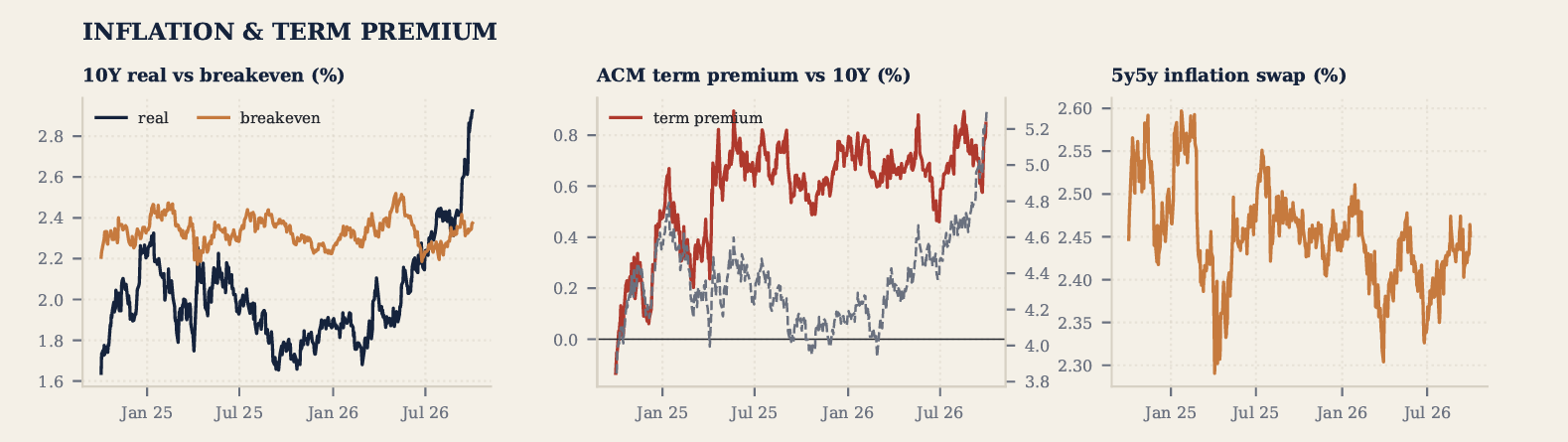
The US equity market finished the third quarter in positive territory, with the S&P 500 closing the quarter up roughly 2%. The main story of the quarter was, of course, US rates. Contrary to many analyses, Kevin Warsh turned out to be the Fed chair who started tightening rather than cutting. I had touched on why a hike might be coming in a tweet before the meeting. (Tweet) Although he took an important step toward regaining credibility, we saw that long-term yields did not price this in. For now I should note that only real yields have risen; there has been no development in term premium or inflation swaps that would warrant concern. As for the rise in real yields, plenty of reasons can be found: the war, high nominal growth, tightening in Japan and so on. My view is that although an attractive yield level has formed here, I cannot see a reason for the current trend to reverse. At some point I think the levels will become too good to refuse, but I am not yet sure about the timing.
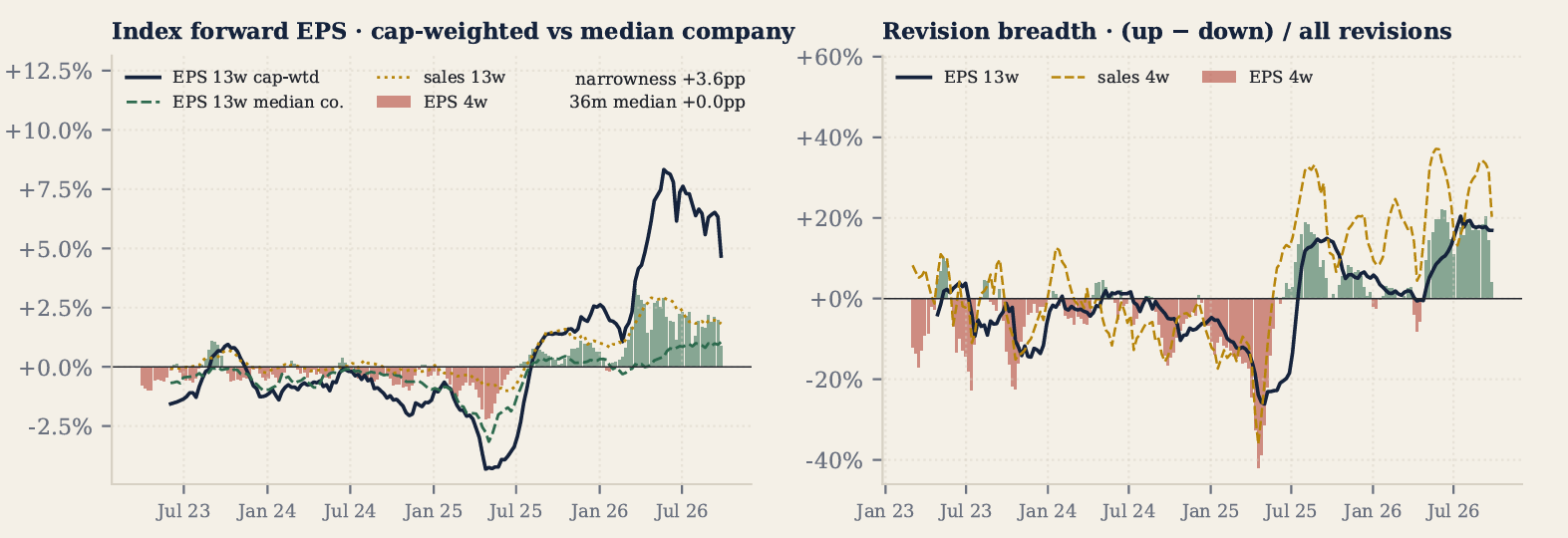
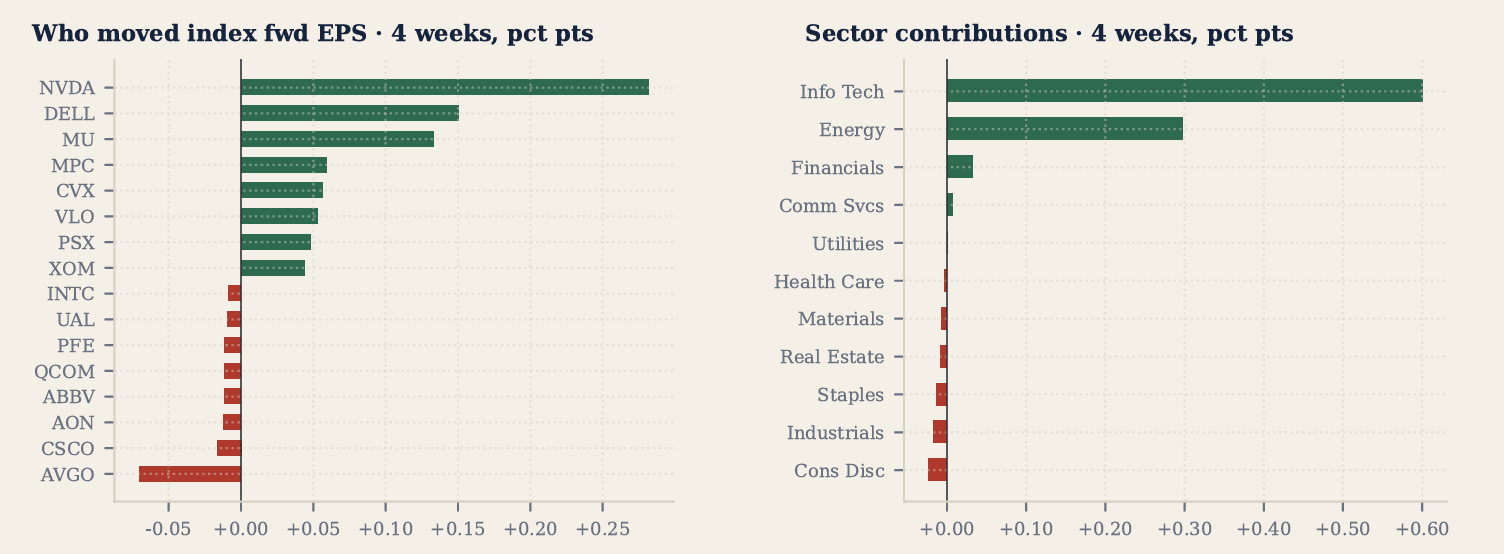
The strong picture in US equities continues. The reason the index has managed to stay near its highs in this rate environment is the strong earnings revisions on the technology side. But the chart shows how narrow a base these revisions rest on. The 13-week forward EPS revision is 4.6%, while for the median company the figure is only around 1%. The gap between the two, at 3.6 points, is well above the three-year median of zero. More importantly, the retreat of this gap from its spring peak of nearly 8 points stems not from the median company getting stronger but from the slowing revision momentum at the large companies. You can see the details in the revision breadth chart below. Although upward revisions still dominate, momentum has weakened markedly in the last four weeks of data. In short, the direction of revisions is still up, but their momentum has turned down. Part of this loss of momentum is probably a function of being past earnings season, so the next quarter’s results will give us a better sense of direction.
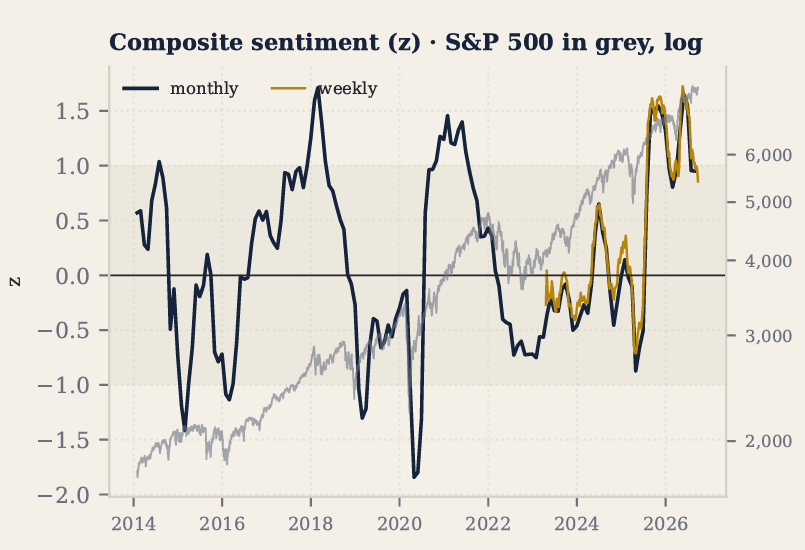
Finally, looking at investor sentiment, the composite sentiment indicator I built has stayed above the minus 1 to plus 1 standard deviation band considered normal for most of the past year, in other words in the excessively optimistic zone.
As for my own view, although the signs of excess in markets have multiplied, I still cannot see a catalyst for it to end. There is no deterioration yet in company backlogs, and on top of that there is additional demand that may come from areas such as agentic AI and robotics. Add the competition between states to all of this and we are facing an AI race that concentrates every resource of the economy on itself and cannibalizes other sectors. In the fund, we continue to invest in the companies we find reasonable in this space, within their risks.
Turkey
The quarter was quite harsh in Turkey. The BIST 30 Index closed the quarter with a 16.7% loss. The selling stemmed not from a deterioration in macro balances but from a market-specific confidence shock and the position liquidation it triggered. The indicators below show this too, and they form the main reason we see Turkey as one of the opportunities of the coming period.
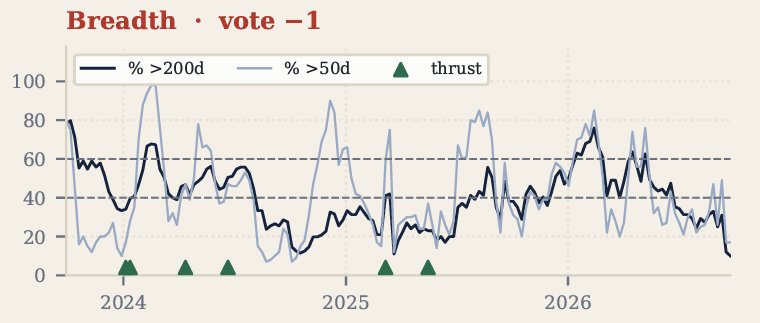
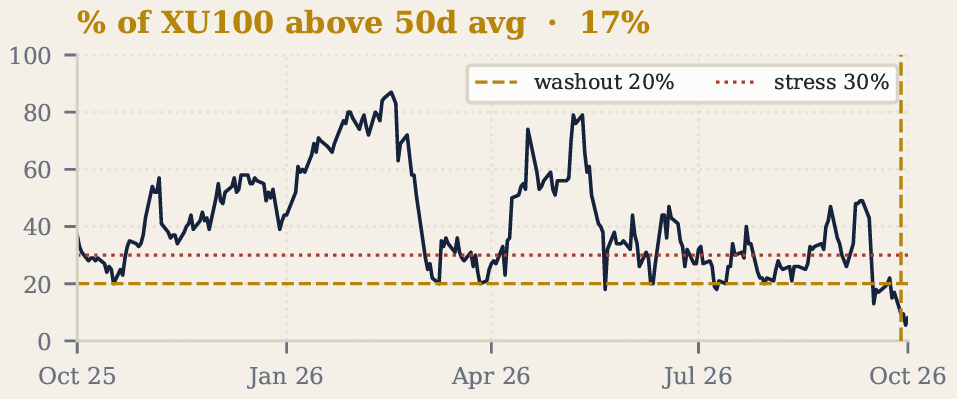
I will not comment here on the developments on the fund side, but I do need to address the effects on the stock market. From an investor’s standpoint, we are facing an incredible opportunity set: companies fundamentally untouched by the liquidation but exposed to selling pressure in price terms. I do not think the stress will create systemic risk. The forward expectations of many companies, and Turkey’s forward inflation expectations, did not rise with the liquidation. On the contrary, the lost wealth effect may even create a negative inflation shock. The economic administration, for its part, is behaving proactively after the liquidation and appears to have learned from earlier mistakes in both communication and action. I believe they will provide the necessary measures or comfort to the market in the event of any liquidity squeeze.
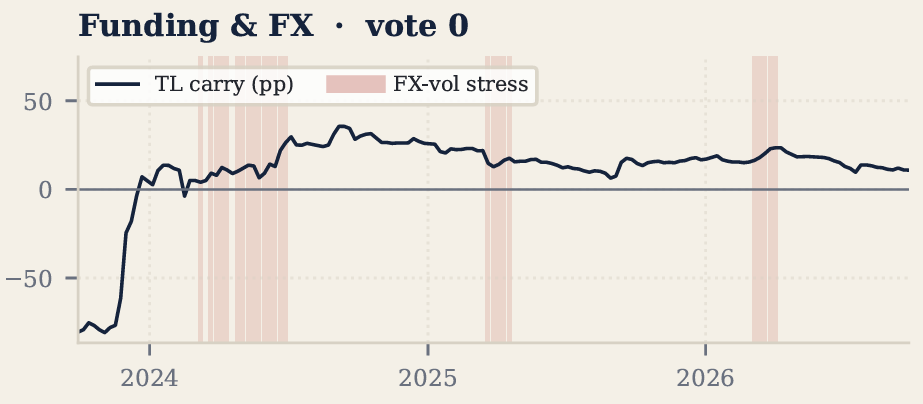
Currency movements, the number one leg of the program, were perfectly healthy and showed no stress.
In the CKL fund, we navigated both the run-up to the liquidation and its aftermath well. We have raised our Turkey weight from around 15% at the start of September to 50%. We added to companies whose individual stories we trust and which we find cheap on a sector basis. I continue to favor companies that are resilient to geopolitical developments and fed by domestic demand.
Brazil & India
Within emerging markets I wanted to open a separate parenthesis for Brazil and India, since we find both countries attractive for different reasons. In Brazil, the upcoming election offers an asymmetric return profile. In India, we see the earnings and credit cycle re-accelerating at a time when pricing is quite pessimistic.
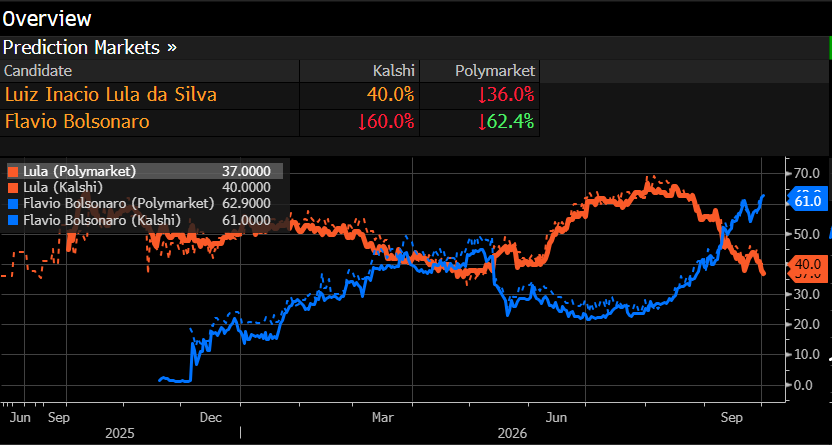
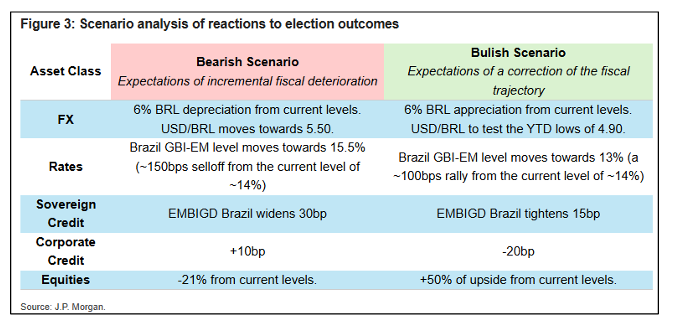
In Brazil, the first round of the presidential election will be held on 4 October, with a second round on 25 October if needed. Whichever way the results go, they will be binary and a catalyst. Similar to what we have seen in other emerging market elections in recent years, the opposition candidate is gaining votes a month before the vote. Below you can see the opposition vote shares in comparable countries. Both the Hungarian and the Colombian elections saw similar trends. If the same happens in Brazil, the potential is very significant.
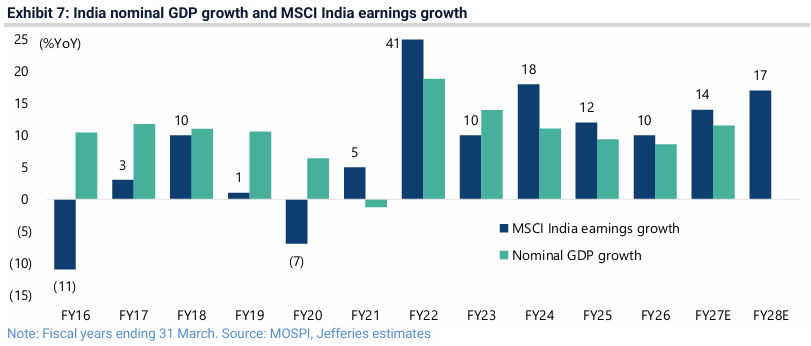
In India, the story is the normalization of the earnings cycle. The chart shows the earnings growth of MSCI India companies alongside nominal GDP growth, on a fiscal-year basis ending in March. Earnings growth, which reached 18% in fiscal 2024, slowed to 12% in 2025 and 10% in 2026 together with the slowdown in nominal growth. According to Jefferies estimates, this slowdown cycle is coming to an end, and earnings growth is expected to re-accelerate to 14% in fiscal 2027 and 17% in 2028.
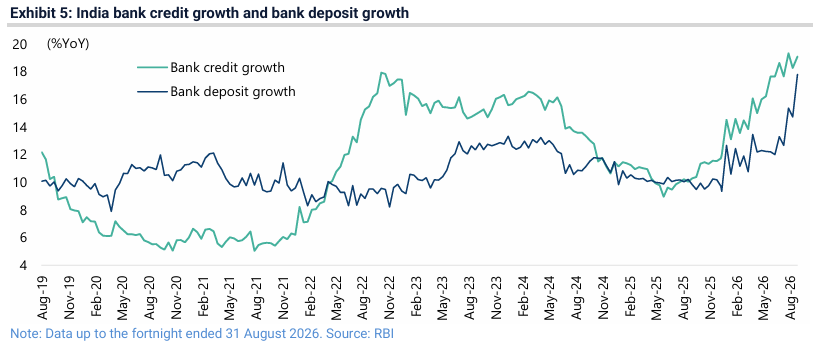
The most important data point supporting the expected recovery in the earnings cycle comes from the credit side. Annual bank credit growth rose from its troughs of 9% to 10% in mid-2025 to 19% as of the end of August, the highest level of the period shown in the chart. More importantly, deposit growth has also jumped to 18% in recent months, catching up with credit growth. In 2023 and 2024, credit growth running well ahead of deposits had left banks facing a funding constraint and slowed the credit cycle. Today the two series rising together signals that credit expansion can continue without hitting a funding bottleneck. That provides a favorable backdrop for both the banking sector and domestic-demand-driven sectors.
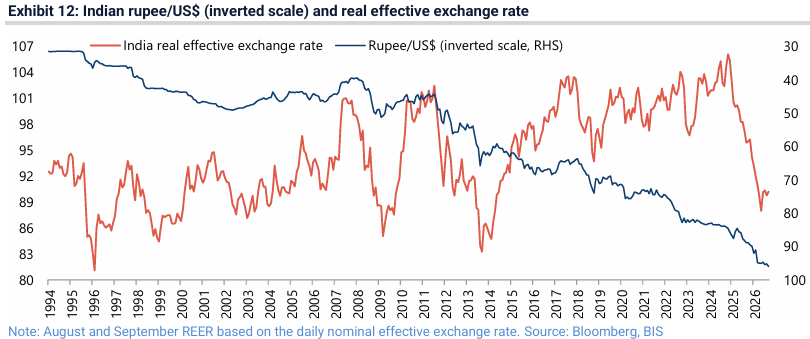
Something investors who know Turkey have experienced closely, India went through in a different form last year. An energy importer, the country had a rather bad year, hit both by a central bank prioritizing growth in the face of rising energy prices and by the sell-off in the software sector. With an index weighted heavily toward financials, industrials and domestic consumption, India in its current composition is, together with Brazil, one of the emerging markets we like.
Commodities
To touch on it briefly: while we do carry positions on the commodity side, our total exposure is limited for now. I added this section mainly to share the signals I read from the pricing of the options markets. Because the options market shows how much investors are willing to pay for risk in which direction, it often carries more information about positioning than price itself.
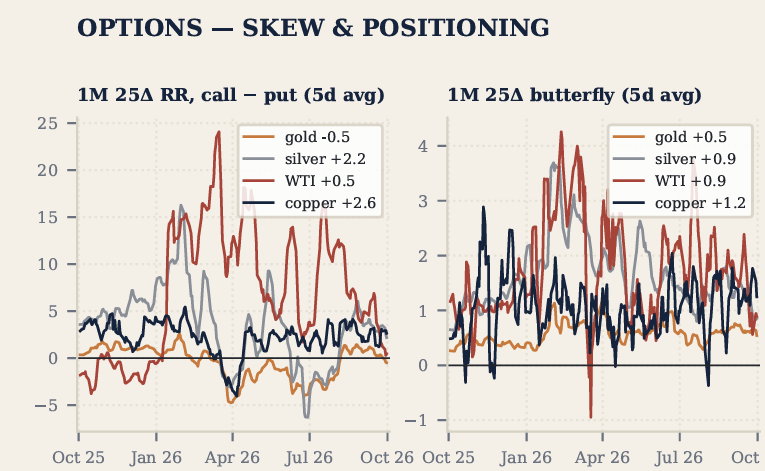
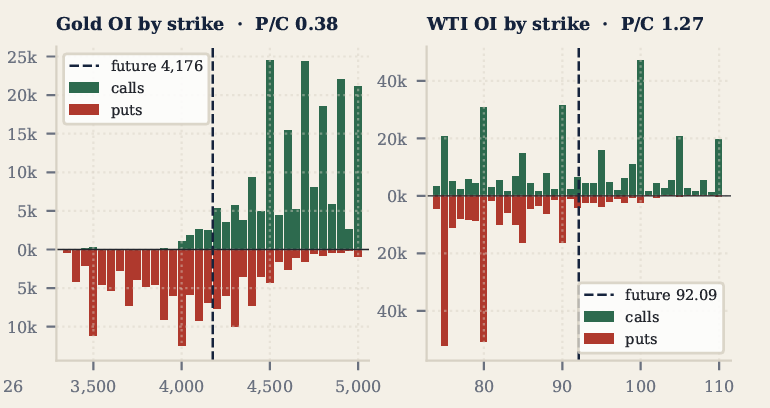
Above you can see the risk reversal (the implied vol difference between call and put options) and the butterfly (the premium paid for tail scenarios). Although investors’ appetite for upside in precious metals has improved from its June lows, positioning is still not back to its former levels. In oil, we see premiums against tail risk shrinking and the market pausing, in a sense. The key levels remain 90-100 in WTI and 4000-4500 in gold.
Disclaimer
This post has been prepared for informational purposes only and does not constitute investment advice, a recommendation to buy or sell, or an offer relating to any security. The views and analyses expressed here reflect the author’s personal assessments and do not represent the official view of any institution he is affiliated with. The author may hold positions in the securities mentioned in this post. Past performance is no guarantee of future results. Every investment carries risk; investors should do their own research and consult a licensed investment advisor where necessary. The information in this post is based on publicly available sources, and no guarantee is given as to its accuracy or completeness.